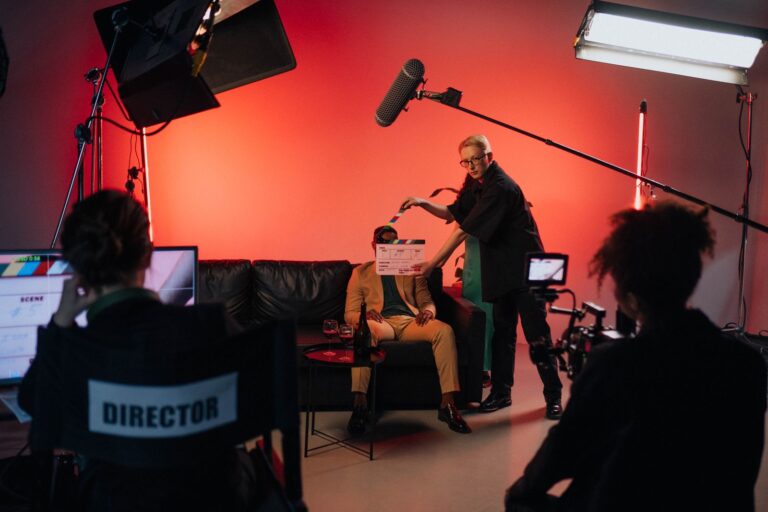
You don't need headshots. You don't need a resume. You don't even need to know what a "callback" is yet. This is the beginner-friendly guide to acting, modeling, and voice-over auditions — explained like a real person is talking to you.


Most people who want to act or model quit before they ever try — not because they weren't good enough, but because nobody told them how any of it actually works. The websites are confusing, the terms are weird, and it feels like everyone else got a handbook you never received.
That's what this site is. The handbook. We break down what auditions are, who can go to them, what casting directors are actually looking for, and how to spot the difference between a real opportunity and a waste of your time.
Not everyone wants to be a movie star — and that's the point. There's more than one door into this industry.
Movies, TV shows, theater, and commercials. This is the classic route — and it's wide open to beginners who show up prepared and coachable.
Catalogs, ads, social campaigns, and runway. Height requirements are way more flexible than the internet led you to believe.
Cartoons, video games, audiobooks, and ads. Nobody sees your face — which makes this the most accessible entry point in the whole industry.
Disney, Nickelodeon, and family productions are constantly casting young talent. Parents: there are real rules protecting minors — learn them here.
Netflix, Hulu, HBO, and Amazon produce more content than ever — which means more roles, more often, for more types of people.
ABC, CBS, FOX, and MTV cast everything from dramas to hosted shows. Background work here is one of the best ways to learn a real set.
Tap whichever one sounds most like you. We'll tell you where to start.
Every path in this industry needs a different kind of person — and there's genuinely a lane for all four of these.
Spoiler: it's way less scary than movies make it look.
"Sides" are just the few pages of script you'll read. You usually get them ahead of time so you can practice.
You say your name and age to camera. That's it. That's the slate. It takes four seconds and everyone does it.
You perform the scene, usually twice. They may give you a note and ask again — that's a good sign, not a bad one.
No feedback, no verdict. You go home and forget about it. If they want you back, that's a callback.
Six things that make a genuinely huge difference — and cost you nothing.
Know your lines cold, then be willing to throw the delivery out. Casting directors want to see that you can take a note and change something on the spot. Rigid perfection reads as nervous.
Auditioning for a student? Wear a plain shirt and jeans. Don't show up in a full costume. Suggest the character — a hint is professional, a costume is distracting.
Unless they tell you otherwise, look slightly off-camera at your reader, not into the lens. Direct eye contact with the camera is for slates and hosting, not scenes.
Show up fifteen minutes early, every time. Sets and casting offices run on tight schedules, and being reliable is genuinely half of what gets people hired again.
Self-tapes are now the norm. A window for light, a plain wall behind you, phone horizontal at eye level, and someone reading lines off-camera. That's a usable audition tape.
This is the big one. Legitimate casting never guarantees you a part in exchange for money. Classes and headshots can cost money; roles cannot be bought. Walk away.
Click any card to flip it over and get the real answer.
Everyone assumes the window closes at twelve.
Productions need every age on screen. Starting later can even be an advantage — there's less competition.
The idea that only one body type gets cast.
Casting breakdowns ask for all heights, sizes, and backgrounds — because shows are about real communities.
The $800 photo shoot before you've done anything.
Get in the room first. Once you know you actually like this, then invest in photos that match the roles you're going for.
The classic reason people never try.
Tax incentives moved shoots to Georgia, New Mexico, Louisiana, and beyond — and self-tapes made location matter far less.
The thing that makes people quit after one try.
You were too tall next to the lead. The role got cut. They went another direction. Working actors hear "no" constantly.
Waiting until you're "ready" to begin.
Classes help enormously — but nothing teaches you faster than actually doing a few auditions and seeing how rooms work.
What it felt like before, during, and after that first audition.
I genuinely thought you had to know somebody. Turns out I just had to know what a slate was. Read this whole site in one sitting and booked my first background gig a month later.
My daughter has wanted this since she was six and I had no clue how to help her without getting scammed. The section on red flags alone saved us from a really sketchy "agency."
I'm way too anxious to be on camera but I've done voices my whole life. Nobody ever told me voice-over was a real option. That reframe changed everything for me.
Deep dives on the stuff that trips up first-timers.
6 min read
From the parking lot to the walk out — exactly what happens and when, so nothing catches you off guard.
Read it →
8 min read
Lighting, framing, sound, and background — the four things that make a phone tape look professional.
Read it →
5 min read
More shows means more roles — and a much wider definition of who gets to be on screen.
Read it →
9 min read
Work permits, set hours, trust accounts, and the protections every parent should know before day one.
Read it →
7 min read
The exact phrases scammers use, and the one question that exposes almost all of them instantly.
Read it →
6 min read
Yes, really — a closet full of clothes is one of the best cheap recording booths there is.
Read it →Walk in already knowing what everyone's talking about.
The couple of script pages you'll actually read at the audition. Not the whole script.
Saying your name and age to the camera before you start. Four seconds, tops.
They liked you and want to see you again. This is genuinely great news.
The description of the role: age range, look, personality, what the scene needs.
An audition you film yourself and send in. Now the most common format by far.
The person who says the other character's lines off-camera while you perform.
Extras. The people filling out a scene. One of the best ways to learn a real set.
You got it. The role is yours. This is the word everyone is chasing.
The honest answers, including the ones nobody likes to say out loud.
Every actor you've ever watched had a first audition where they had no idea what they were doing. The only difference between them and everyone else is that they went anyway.
1930 E. Marlton Pike, Suite W 111
Cherry Hill, NJ
Mon–Fri: 9AM – 5PM
Sat–Sun: 11AM – 6PM
Kids, teens, adults, and parents
All experience levels welcome